Showing posts with label Commentaries. Show all posts

Sunday, April 7, 2019

International Day of Human Spaceflight 2019

Vostok-1 Display.

This Friday, April 12, is the International Day of Human Spaceflight, also known as Yuri's Night. It commemorates the launch of Yuri Gagarin, the first man in space, on mission Vostok-1 in 1961. The purpose of this celebration, held around the world, is to help promote space exploration. In the past I have often missed participating in this celebration because I get too busy and the day kind of sneaks up on you and then - Woosh! - it's gone and I look forward to the next year.

I am unaware of any special parties or events at the Clarke Planetarium, but they do have some great planetarium and IMAX theater shows on space exploration. If you haven't got anything planned and want to join in the fun, take in a show. 

As for myself, I am going to celebrate in my own way - playing space games! I will be at GAJO Games in Sandy, Utah at 6 pm to play the new GMT game SPACECORP - the exploration of the Solar System. SpaceCorp is about developing a space exploration corporation, and reaching out to establish new bases and technology in our solar system and beyond. It includes several layers of games. You start by exploring the inner system, the LaGrange points, the Moon, and the first bases on Mars. Then you move into developing the technology and human presence in the farther reaches of the Gas Giants and the outer solar system. Finally you push to be the first explorers to reach out to the nearest stars.

Box cover art for SpaceCorp.


Game Board for the first phase of space conquest.

What else could you do? How about watch a movie or read a book on spaceflight. Or build a spaceship model. You could build a LEGO spacecraft. (I've started getting some LEGO astronaut figures, and there's a large Saturn-V kit awaiting my attention).  Better yet, if the night weather is good and the sky is mostly clear, grab the binoculars, or if you have one, a telescope, and spend some time stargazing at the real space right above us.

Whatever you choose, have a happy Yuri's Night and celebrate the incredible adventure of space exploration!

Sunday, January 29, 2017

50 Years Ago: Apollo 1 Fire

Astronauts Gus Grissom (L), Ed White (C), and Roger Chaffee (R). Picture taken at Launch Complex 34, with the gantry tower in the background.

Hard to believe it was fifty years ago. On January 27, 1967, we lost three astronauts during a test of the newly-designed Apollo command module  at the eventual launch site. It's a famous event, most of us remember reading about it. Mostly I remember having seen something on TV and having adults tell me what happened. Over the years I learned more and more of the mistakes that were made leading up to the moment of terror when an electrical arc from an exposed wire ignited the 100% oxygen in the test environment. The fire was quick and the intensity so hot and at such incredible pressure that it cracked the hull of the capsule and prevented immediate attempts to rescue the crew. But it was too late - the crew died firstly from the toxic fumes. Today I don't want to remember the scenes of the aftermath, there are plenty of sites on the Internet and a plethora of books describing it all. I like to picture them as they were before the fire, as shown above.


Above is an aerial view of LC-34. It was taken in 1963 during preparations for SA-4, a test launch of Saturn 1. You can see the twin gantry towers, which is the red tower complex seen in the first photo. A test Saturn rocket sits on the concrete pad base attached to the launch tower. The circular building is the launchpad protective firing room. It's obvious how close the pad was to the shoreline. Today it is all gone, except for the roads, concrete pads, the rocket launch base, and the firing room bunker. 


The photo above is from my last trip to the Cape. This is the approach road to the complex on the western side. The concrete pads are out of sight to the right, while in the distance you can see launch towers from LC-37 ( still active launch site) on the left. You can visit the site if you take the Cape Canaveral AFB tour from the Kennedy Space Center visitors Center. This tour is only available during days when no rocket launches are planned, and I think only one tour a day is allowed. 


The tour bus lets you off within walking distance of the launch pad base. The tower itself was scrapped years later, as were most of the facilities on old launch pads. It's actually quite a wide concrete base. There is a great feeling of quiet there except for the wind that blows towards the Atlantic just a short distance away.


This picture gives a greater sense of the size of the base related to human height. As you can see, weather and age are having its toll on the structure. There is some talk of tearing it down, but I would rather see some funds put into an effort to restore it. I would love to see NASA build a small building here to protect it from the elements and display in miniature how the pad looked and operated. To me, the pads are just as important as the rockets.


Next you can see the gigantic opening made for the flame exhaust from the mighty Saturn 1 engines. I believe the tubular ring is part of the fire suppression system to lesson the ground shock of the engine power. There is something symbolic in being able to look upwards towards space through this open portal. 


These are the blast deflectors which would be placed under the rocket to deflect the fire and exhaust to a horizontal direction, avoiding a wave of pressure and flame from rebounding off the ground and damaging the engine section. These were not scrapped yet when I visited, and are stored at the edge of the giant pad. In the old picture of the pad, click it to enlarge it, and look behind the left side of the towers about midway up, and you can see on of these deflectors. That's where they still are.


 From the launch tower base, you can look somewhat south and see the firing room bunker. In case of danger, the crew would be evacuated from the rocket, and taken up a long protected tunnel to the blast-resistant bunker. You can find it in the old complex photo very easily.


This is a view of the Firing room bunker as we drove past it in the bus. There was no stopping here, the bunker is off-limits to the tour. Our guide did not know if anything has been preserved inside the bunker. It was planned that the Saturn 1b rockets would launch from this pad complex, and the launch control room would have been in here. As it was, four Saturn 1 test launches were from here, and there were two Saturn 1B test launches from this pad before the Apollo 1 fire. Afterwards, the return of astronauts to space took place in the next manned launch, Apollo 7, from this complex. Operations then moved to the LC-39 complex.

When you walk under the launch base, you can feel history there. You sense the reverence and awe in the fellow visitors, and everyone whispers even though we are out in the open. This is part of our great space race past, and it is a place that deserves to be preserved and visited.

Tuesday, April 12, 2016

Bigelow and ULA Deal: Space Real Estate For Sale!

The Shape of things to come: A Bigelow B330 station in orbit with commercial capsule and solar powering unit attached. Credit: Bigelow Aerospace.

This is a good week. And for space enthusiasts, our tomorrows are looking brighter! On April 11, Bigelow Aerospace (producer of the inflatable space module idea) and ULA (United Launch Alliance, the corporation that launches the Atlas V rocket and payloads) jointly announced their plan to launch into Earth orbit two of Bigelow's giant B330 inflatable space stations. The modules would be launched aboard the reliable Atlas V rockets, and provide, for the first time, a commercial (non-governmental) foothold in low Earth Orbit that could be rented by corporations or countries for space research or space tourism.

 
Artist's rendition of how the BEAM will look when attached to the ISS. Credit: Bigelow Aerospace.
Currently, NASA is about to test the first ever Bigelow Expandable Activity Module (BEAM) when it removes the collapsed module from the recently arrived SpaceX Dragon cargo ship, and attach it to the U.S.-built Tranquility module on the ISS. It will be deployed, then studied for a two-year experiment that will help convince NASA engineers of the viability of using the expandable modules for future space station design. To this date, Bigelow has already had two expandable test units launched into free-floating orbits for testing, and they worked excellently.

Cut-away view of the inside of the B330 Module. The size advantage is obvious. Credit: Bigelow Aerospace.
 Bigelow calls the B330 "a game changer," and it is. The 330 refers to 330 square feet of room inside the module. It has a central, or core unit that includes the electronics and equipment. The outside walls of the module are expanded out from the core, and are made of up to 36 layers of vectran, which is far stronger than kevlar and more flexible. The outer layers would provide better protection from radiation and micrometeroid strikes than the current walls of space station modules. With 330 square feet, a B330 has almost three times the space of the US Destiny module on the ISS. It will be fitted with a docking port compatible with the different commercial spacecraft under development as well as NASA's Orion and the Russian Soyuz.

NASA's assistant director Lori Garver inside a mock-up of a Bigelow module gives an idea of the spaciousness inside the module. Credit: NASA.

Expanded arrangement showing how the B330 would be transported aboard the Atlas V rocket. Credit: ULA.
To get the B330s into space, ULA plans to use the Atlas V rocket with its large payload version with expanded fairings to protect the large B330 core assembly. For extra propulsion, the rocket would be assisted with 5 solid rocket boosters. With these two facilities in space, ULA predicts additional flights when its Atlas rockets are used for launching commercial capsules (such as the Boeing CST100) to dock with the modules.

Expanded space station proposal beyond the B330.
Credit: Bigelow Aerospace.
The Bigelow/ULA plan schedules these modules to be placed in Low Earth Orbit in 2020. Current NASA plans suggest that the ISS project would be terminated by 2024. The ability to install a B330 onto the ISS has been brought up as a way to extend the life of the station and open it to a greater use by other corporations and other countries' space programs. With two additional stations in orbit, we will finally have additional destinations for commercial programs besides a restricted, government-controlled space laboratory. Whether for business use or as a "space hotel" for space tourism programs, the B330s will provide the first available "real estate" to be purchased in orbit. I have always said that our space programs will be very limited until someone figures a way to make money in space. Just like the birth of aviation, mere flights for the experience were not enough to provide room for the development of airlines and airliners; people wanted a place to go to and visit.

Another space station concept. Add a propulsion module and it could fly to Mars. Credit: Bigelow Aerospace.
Bigelow modules also offer opportunities for human exploration of the solar system. No one would want to fly in a cramped Orion capsule all the way to Mars or beyond. But add some Bigelow modules, and you'll have the space you need to live in on those long journeys. There are even plans for placing variants of the modules on the lunar surface to create the first lunar permanent base.

Orbiting the Moon: Two B330 modules with a couple of Orion capsules and some power units attached. Our first Lunar station in orbit? Credit: Bigelow Aerospace.
The success of Bigelow module structures will make an expansion of the space program achievable and more affordable. One can easily imagine how popular it will be to have a space hotel in orbit of the Moon with a short 2-day flight to the station and a 2-day return. Yes sir, space travel is about to get A LOT more interesting!

Friday, February 5, 2016

2016: A Good Year for Rocketeers

Launch of Atlas V carrying the 12th GPS satellite for the US Air Force's Network of navigation satellites. Credit: United Launch Alliance.

This morning the weather looked clear as ULA launched another Atlas V rocket from Launch Complex 41 on Cape Canaveral, Florida. The GPS-IIF-12 satellite was successfully placed into orbit,  completing the constellation of navigation satellites planned by the USAF.  This was the first ULA Atlas V launch of the year, with a plan of 15 ULA launches throughout 2016. When you add these flights to the other commercial launches, and all the international launches scheduled this year, it looks to be an exciting time for fans of rocketry and satellite launches!

On my SpaceRubble blog, I don't usually cover every rocket launch, instead focusing on missions that support manned space projects or important exploration probes to the planets. But a rocket fan can easily keep up with all the blasting off, thanks to websites such as: 


Friday, January 2, 2015

Upcoming NASA events for 2015

Dragon cargo spacecraft approaches the ISS in a computer rendition.

Looking ahead to the events in 2015, we can find definite progress to that happy day when the USA finally gets its own manned rockets to orbit. We still have a couple of years wait, though. For now, we look forward to a launch of the SpaceX Dragon cargo spacecraft on January 6, which will rendezvous with the International Space Station and the current members of Expedition 42. Scheduled times for launch and TV coverage found at NASA's site: https://blogs.nasa.gov/spacestation/2014/12/31/happy-new-year-16-times-on-space-station/

Space explorer DAWN approaches the minor planet Ceres. NASA computer illustration.

With the agency's current White House mandate to prepare for a trip to send humans to rendezvous with an asteroid (whether that actually happens still is up in the air), it's interesting to find NASA's DAWN spacecraft just about to rendezvous with the asteroid-now-minor-planet Ceres. The spacecraft had just recently been on the other side of the Sun from Earth, but has now cleared the blocking solar disk and NASA can prepare the craft for its final approach to the Texas-sized dwarf planet. Zooming towards Ceres at 450 mph, the craft will arrive on schedule on March 6th. You can read more about the mission at NASA's site: http://www.nasa.gov/jpl/dawn/dawn-spacecraft-begins-approach-to-dwarf-planet-ceres/index.html#.VKa73yjqG0J

SMAP images soil moisture. NASA image.

NASA will continue it's White House mandated efforts to study carbon dioxide, Earth global warming, and support Earth-oriented missions. On January 29, NASA will launch SMAP, the Soil Moisture Active Passive instrument designed to study the amount of moisture in the Earth's soil. This will be the 5th Earth Science mission launch within the last 12 months. You can read about SMAP's mission here: http://www.nasa.gov/jpl/smap/technology-innovations-spin-nasas-smap-into-space/index.html#.VKa8yCjqG0J

Computer art of Cygnus craft at ISS.

Since the explosion of the Antares rocket and Cygnus cargo spacecraft at Wallops Island last October, parent company Orbital has been busy making repairs to the launch pad and working to clean up environmental contaminants on the beach. It's estimated that Orbital will be ready to launch Cygnus again, perhaps this time on an Atlas V rocket, by end of December 2015. A new version of the Antares rocket will be testing by then.

Dragon V2 on left, CST-100 on right. NASAspaceflight.com combined image.

With NASA"s approval last month for Dragon to proceed with it's manned capsule testing, the Commercial Crewed Vehicle program continues through 2015 between both SpaceX and Boeing. Boeing continues testing it's CST100 capsule and SpaceX will now start testing the actual Dragon2 articles and escape systems. 2015 will be an important year for testing. For now though, we continue to spend millions and missions of dollars on rides with the Russians.

Russian spacecraft docked at ISS. Older picture from 2009. Doesn't look a whole lot different now.

Up in space, Expedition 42 continues to perform experiments, do science, maintain the ISS, and this year they will continue preparations to move some modules around to accommodate the future docking of the commercial spaceships. We can also look forward to a year-long experiment when astronaut Scott Kelly and cosmonaut Mikhail Kornienko  join the ISS team later in 2015 to spend an entire year aboard the station. 

And of course, space activities will be plentiful each month. We can look forward to monthly launches from Russia, China, European Space Agency, India, Japan, and of course the USA.

Sunday, May 11, 2014

Expedition 39 Prepares for Transition

In a recent crew picture, the current Expedition 39 crew poses "Encircling the Earth." At bottom is Expedition Commander Koichi Wakata of the Japanese Aerospace Exploration Agency (JAXA). Clockwise from him is Alexander Skvortsov, Mikhail Tyurin, Steve Swanson, Rick Mastracchio, and Oleg Artemyev.

Crew members of the 39th expedition to the International Space Station are preparing for a week of station departures. On May 13th, Expedition 39 Commander Koichi Wakata, Soyuz Commander Mikhail Tyurin, and Flight Engineer Rick Mastracchio will depart from the ISS in Soyuz spacecraft TMA-11M and land Tuesday night in Kazakhstan. On Sunday May 18, astronauts will undock the Dragon cargo spacecraft so that ground controllers can direct it to a re-entry and splashdown in the Pacific Ocean.

Rick Mastracchio operates experiments on the Harmony module. He's working inside the Micro 7 BioCell experiment chamber.

Around and between the departures, astronauts and cosmonauts work on maintenance of the station and  operation of the science experiments. On Thursday a power channel connected to one of the Solar Panel arrays blew and ceased transmitting power. According to procedures, a backup power channel kicked in and the station had no interruption of operations.

Astronaut Steve Swanson works with experiments on the BioRack inside the Japanese Space Agency Kibo module. Swanson is designated to become the next expedition commander when Expedition 39 departs Tuesday.

Astronauts also completed transferring important used equipment, experiments, and science samples into the Dragon spacecraft. Normally, waste and garbage is packed into the cargo ships for disposal when the craft burns up in re-entry. However, the Dragon is the only cargo spacecraft that returns to Earth for a safe Splashdown and Recovery. Astronaut Steve Swanson spent Saturday training with the Canadian-built RoboticArm which he will use to move the undocked ship away from the station.  Astronauts also worked to complete storage of personal and important items in the cramped Soyuz capsule.

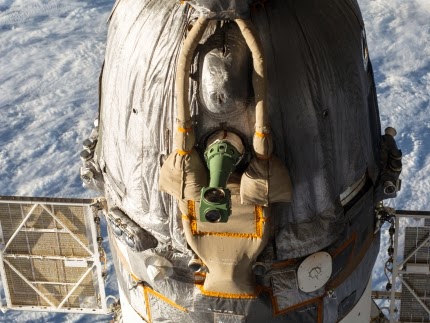
Picture through a station window of the Soyuz capsule command section. The green extension device is the Periscope which allows Soyuz occupants a direct forward view. As the Soyuz command section (which completes the trip back to Earth) is in-between the science/payload section and the service section (both of which burn up on re-entry) the occupants cannot have a direct view forward and must use the periscope.

One of the station astronauts took this picture from one of the station's windows. We see a half-lit Moon
above the Earth on May 6th. Currently, the ISS is mankind's manned outpost in space, albeit in Earth orbit and totally dependent on re-supply from the planet below. Looking to the Moon, I think of the days when we were so hopeful and forward thinking that we completely expected to have a permanent base on that body by now. The fact that we don't is an indictment of our wishy-washy politics and failed leadership to provide a sustained vision of space exploration.

Friday, June 7, 2013

Another Asteroid Passes close to Earth

Asteroid orbit path comes close to Earth, left of center.

2013 continues to be the Year of the Asteroid Menace. Today a recently-discovered asteroid, 2013 LR6, will approach the Earth's orbit today and pass close by tomorrow. The 50 foot-wide rock will come closer than does the Moon, at about 68,000 miles (the Moon is at about 240,000 miles). That's close in NEO terms (Near Earth Objects). 

Yahoo News has a good article explaining more about this event and a link to watch the approach LIVE: http://news.yahoo.com/asteroid-fly-within-moons-orbit-tomorrow-watch-live-153153909.html

From the SpaceRubble Command Bunker: We often hear that scientists have discovered such-and-such percent of the asteroids that could hit us. Yet rocks such as this one, the recent big one and the Chelyabinsk meteor hit prove that it's the ones you don't see coming that are the true danger to the Earth. And if they aren't seeing all of them, then we really don't have a number we can pin a percentage on, we only have a Wild-a** guess to go on, 'cause who in the heck knows everything that's out there in space!

Thursday, April 25, 2013

50 Years Ago: President Kennedy Defends Space Budget

President Kennedy awarding NASA Administrator James Webb.

I almost missed this item from yesterday's look at the NASA archives. On April 24, 1963, President John F. Kennedy  participated in a press conference where he was asked if he "had any cause to reconsider" his commitment to goals to US lunar program. I think his answer is was not only important for his day during the development of the Apollo and Gemini programs, but it also applies to the importance of our space program today. Let's look at his profound answer:

"We looked at it, of course, when we proposed our budget for this year. We are looking at it again in relationship to next year's budget. We are also looking at it because of the concern that has been raised in the Congress and out of the Congress. I have seen nothing, however, that has changed my mind about the desirability of our continuing this program.

"Now, some people say that we should take the money we are putting into space and put it into housing or education. We sent up a very extensive educational program. My judgement is that what would happen would be that they would cut the space program and you would not get additional funds for education. We have enough resources, in my opinion, to do what needs to be done in the field, for example, of education, and to do what needs to be done in space.

"Now this program passed almost unanimously a year ago. What will happen, I predict, will be a desire, perhaps, possibly, to cut it substantially, and then, a year from now or six months from now, when the Soviet Union has made another new, dramatic breakthrough, there will be a feeling of, 'Why didn't we do more?' I think our program is soundly based. I strongly support it. I think it would be a mistake to cut it. I think time will prove, even though we can't see all the answers which we will find in space, that the overall expenditures have been worthwhile. This country is a country of great resources. This program in many ways is going to stimulate science. I know that there is a feeling that the scientists should be working on some other matter, but I think that this program – I am for it and I think it would be a mistake to arrest it."

It certainly looks like President Kennedy understood Congress.  Let's examine a couple of Kennedy's points. First: Cutting Space Program money to spend more on education and housing. History shows, that after Kennedy's assassination and President Johnson's extremely expensive "war on poverty" and enormous increases in education, Congress cut the space program drastically. For a period of 6 years, we were unable to send astronauts up into space (does that sound familiar?) And did the increases in spending achieve their goal. The result is a giant NO. Poverty levels have increased since then, and America places worse in educational results than we did in 1963. We can easily see through history that Congress is terrible at budgets and cannot control its spending habits. On the other hand, we can easily see that the spending in the space programs were of enormous benefit to the country, and the world, in the spinoff technological developments that went from exploring space and into the private sector. Few government programs have the spinoff benefit record that NASA has. SOmething we should consider today.

Second: Kennedy foresaw that other countries, in this case the Soviet Union, sought to beat the US in technological leadership, and that eventually something would happen and we would regret giving up our leadership in space. The same holds true for today. Although the Soviet Union is no more, Russia under Putin is determined to eventually replace us as the world leader in space technology. China seeks to do the same, AND is also involved in advancing techniques to destroy their opponent's satellites in space. 

Third: Kennedy believed that the space program would stimulate science. We certainly saw that with the Space Race. The drawdown from the space program of the last decade also takes lace during a time of a loss of industry and technological advances. We hear our leaders talk about a famine of American science students in our industry. Foreign students learn in our universities and then take that knowledge back to their countries, instead of immigrating to America. There is a push now for STEM and more science education. Well if you want that area to grow, we need to have some space heroes, some space adventures, and some great discoveries. As much as I believe in the importance of the science programs in the ISS, I think we have reached the point where it is up to private industry to make the leap from government support to finding wealth in space. We need to have a gold rush in space.

Sunday, January 6, 2013

Rocketing into 2013

Mercury 7 Logo.

Now that we've moved on to 2013, my coverage of 50 Years Ago was lacking an important document: a Chronology of 1963! Thankfully I managed to wind my way through the twisting corridors of NASA documents and found what I was looking for, so I'll soon be posting more blasts from the past of America's Space Program 50 YA. This year we'll be looking back at the last of the Mercury missions, the development of Gemini and Apollo, new missions to the planets and the Moon, and of course the tragic death of President Kennedy. 

In my coverage of current events in space, I'm going to try a new format I've seen other bloggers use, that of short descriptions of an event tied to a link where you can find a much better resource than my own words. I plan to make more commentaries of the development of commercial space, politics in space, and also some posts on being a spaceflight fan and ways I incorporate space-related hobbies.

As for astronomy, I continue my interest in Near-Earth orbiting asteroids. I'm a big fan of Meteorite Men on the Science Channel, and I'm hoping to stake out some meteor showers this year. I will also be increasing my personal binocular astronomy time, and will report on my object safari quests. So, "Ad Astra" and away we go!

Tuesday, September 18, 2012

Armstrong's Life Commemorated

The Colors paraded at the Armstrong memorial gathering.

On September 13 the nation gathered together at the Washington National Cathedral to remember our first Moonwalker. Televised on NASA TV, and covered by Fox News (the other networks did not cover the event) the memorial brought together fellow astronauts, family and friends, and national leaders to remember and honor the life of one of America's greatest heroes. 

The U.S. Navy posting the colors. Armstrong was a naval aviator before joining NASA as a civilian astronaut.

The speakers at the meeting talked about Armstrong as a dedicated engineer who loved exploring through science and adventure. They also spoke of his love of flight, and his great ability to inspire others. Speakers included Eugene Cernan, the last astronaut to walk on the Moon, former Secretary of the Treasury John Snow (a close friend of Armstrong), Administrator of NASA (and shuttle astronaut) Charlie Bolden, and religious leaders at the Cathedral. Michael Collins, the command module pilot of the Apollo 11 mission, led the congregation in scripture and prayers. Jazz singer/composer DIana Krall gave a moving rendition of "Fly me to the Moon" made famous by singer Frank Sinatra. There was also music by the U.S. Navy band "Sea Chanters," the Metropolitan Opera Brass, and the Cathedral Choir. It ended with a moving eulogy by Rev. Mariann Budde.

If you have the time, it is well worth your while to watch the proceedings at the NASA website. But be prepared to shed some tears. You can watch it at: http://www.nasa.gov/multimedia/videogallery/index.html?media_id=152200361

After the memorial, the Armstrong family and other officials were hosted by the U.S. Navy on board the warship U.S.S. Phillipine Sea. Armstrong's ashes were buried at sea by Navy custom.

Farewell, Neil Armstrong.

Wednesday, August 29, 2012

Neil Armstrong is Remembered

Neil Armstrong, official NASA photo. Known as a "WSS," or "White Space Suit" image, this type of portrait became the iconic image of the American Astronauts.

It was inevitable, you know. Last Saturday the family of astronaut Neil Armstrong announced that he had passed away due to complications from heart surgery performed a couple of weeks before. Born in 1930, Armstrong was 82 when he died.  All of our Apollo astronauts are getting along in age. Some have passed on already, like Alan Shepard (First American in space, and commander of Apollo 14) and Jack Swigert (command module pilot, Apollo 13). The Apollo astronauts all remain in our hearts as heros of space education.

But Neil Armstrong, and his Lunar Module Pilot Buzz Aldrin, have the distinction accorded to few astronauts who have ever flown. Because of their famous and dangerous first landing on the Moon in the Apollo 11 mission, their names are forever enshrined in our memories. Perhaps because school textbooks have only so much space for history, or perhaps because television documentaries mention them more than the others, it seems to me that theirs are the first astronaut names that come to mind of the general public.

I know this, because for years, working at the Christa McAuliffe Space Education Center, I have questioned children and adults alike as they visited us. I've asked "trivia questions" to see what the general public really knows about our space exploration history. And I've come to several generalized conclusions:

1) Ask any kid "which  astronaut" did whatever, and their first response is almost always Neil Armstrong. Asked to name a second astronaut, they often respond Buzz Aldrin (although some kids enjoy saying, "Buzz Lightyear".

2) Older people always know about Apollo 11. Some people remember Jim Lovell in command of Apollo 13 (thank you Tom Hanks and Ron Howard!).

3) Many older people remember Alan Shepard as the first American in space, but have forgotten that he also walked on the Moon (and played golf there!).

4) Many people remember a Russian was first is space, and half of them remember his name was Yuri something.

5) The number of kids and adults who have a good knowledge of the other astronauts in space history is rare.

With the passing of Neil Armstrong, I've enjoyed talking to people about what they remember that incredible day of July 21, 1969. Everyone who witnessed it on TV remembers where they were and what they were doing. It was a world-wide event, and one of those generational moments when the world and nation came together in awe. I won't go into Armstrong's career here, as there are many other tributes being published this week. But I would like to take a moment and let you know that Neil was not alone, he served with a team of heroes that prepared for and/or went to the Moon, and here they are:

Apollo 11: Neil Armstrong (deceased 2012), Buzz Aldrin, Mike Collins
Apollo 1:   Virgil "Gus" Grissom, Ed White II, Roger Chaffee (All perished in the Apollo 1 fire-1967)
Apollo 7:  Wally Schirra (deceased 2007), Don Eiselle (deceased 1987), Walt Cunningham
Apollo 8:  Frank Borman II, Jim Lovell, William Anders
Apollo 9:  James McDivitt, David Scott, Russell (Rusty) Schweickart
Apollo 10: Tom Staffard, John Young, Eugene Cernan
Apollo 12: Pete Conrad, Jr (deceased 1999), Richard Gordon, Alan Bean
Apollo 13: Jim Lovell, Jack Swigert (deceased 1982), Fred Haise
Apollo 14: Alan Shepard Jr (deceased 1998), Stuart Roosa (deceased 1994), Ed Mitchell 
Apollo 15: David Scott, Alfred Worden, James Irwin (deceased 1991)
Apollo 16: John Young, Thomas "Ken" Mattingly II, Charles Duke
Apollo 17: Eugene Cernan, Harrison "Jack" Schmidt, Ronald Evans (deceased 1990)

Please remember them all.

Thursday, July 26, 2012

NASA's SLS Rocket System Passes Concept Step

SLS transportation system concepts.

Today marks an important step in NASA's plan to replace the Space Shuttle as the nation's primary space exploration vehicle. According to NASA reports, the SLS (Space Launch System) program has passed all the necessary milestones to move from the concept phase to the actual design phase. The next major milestone will be a design review later next year. Actually, spacecraft components for the system are already in material assembly and testing, such as the Orion capsule, and the core stage (Boeing) and upper stage engines. ATK in Brigham City, Utah (Yay!) is testing the solid rocket boosters ahead of time. The first test launch is scheduled for 2017.

Keep in mind that the SLS is NOT meant to replace the shuttle's use as a transportation system transferring astronauts back and forth from the International Space Station. NASA (and space exploration fans) are pinning their hopes on privatized commercial transportations systems (such as SpaceX's Dragon or ATK's Liberty) to provide that function. SLS would only be used in that purpose in the case of an emergency. 

The purpose for SLS is to provide a heavier lift system to move astronauts into exploration beyond Earth's orbit. Under the Obama Administration's plans, NASA is exploring possibilities of sending astronauts to explore asteroids and prepare for future Mars exploration. The are also many who would like a return to the Moon for further exploration and development of mining opportunities.

Opinion: Overall, there is much that is similar between this design and the cancelled Constellation program design. One has to wonder at the political maneuverings that took place to cancel the Bush administration's exploration plan (admittedly underfunded and late) and the commencement of a bigger, more expensive Obama-administration design (which will no doubt end up underfunded, and late). Only time will tell. But I am pleased to see actual progress in a system that I think the nation needs for exploring anywhere beyond Low Earth Orbit.

Thursday, May 17, 2012

Going Back to Space: ATK 's Liberty rocket

ATK's Liberty rocket and capsule program.

With the end of the shuttle and the Space Transportation System (STS), it seemed to some outsiders that ATK would no longer have a market for those large 4-segment Solid Rocket Boosters (SRB's) that propelled the shuttle orbiters into space. Also not boding well for the company was the cancellation of the Constellation program and the Ares rocket system after only one test of the Ares 1-X. But you can't keep a good team down. ATK has bounced back as a major competitor in the CCD race to space.

Comparing the commercial rockets under development or already available. "A" is the SpaceX Falcon Heavy, still under development. "B" is the Liberty rocket.

ATK has joined forces with key companies to put together the Liberty commercial crew transportation system. With ATK providing a 5-segment SRB first stage, the makers of the Arianne rocket, Astrium, providing the liquid-fueled second stage, and now Lockheed Martin providing support for ATK's Liberty capsule, all the components are together.

Computer illustration of Liberty on crawler/tower moving to the pad. The Liberty is almost as tall as a Saturn rocket, but a great deal less expensive!

Because much of the hardware of the rocket is already tested and flown, it remains to ATK to assemble the package and flight test it and attain a human-rated approval. The toughest part of the process will be quickly developing a crew capsule. And ATK has that in hand, as well. Between 2007 and 2010, ATK had built a composite-structure capsule for a NASA program to reduce risk in transporting humans to space. Now ATK will modify the capsule to fully comply with safety and engineering requirements.

Component-ready Liberty. SRB's from the shuttle, liquid-fuel stage from the Arianne. Capsule by ATK with Lockheed support.

ATK also has the most ambitious schedule of the companies racing to provide commercial crew service. According to their plans, the first unmanned mission will launch in 2014, with the first crewed spaceflight in 2015. This would place ATK a year ahead of SpaceX Dragonrider, and several years ahead of NASA's SLS/Orion system.

5-segment SRB first stage testing in Utah.

ATK is finishing testing of the SRB first stage in the Utah test facility. They are also working on the launch abort system that could save the crew capsule in an emergency on the pad or during launch. As you can see from the picture below, progress is moving at a rapid pace on the Liberty capsule.

Engineers preparing the composite-structure spacecraft.

Barring any unforeseen difficulties in testing, my money would be on ATK to be fairly close to its schedule projections. The project is led by former astronaut Kent Rominger and the ATK team is experienced in building space technology systems. Keep an eye out for more news from ATK as their systems get ready for launch.

All images for this blog post are credited to ATK.

Wednesday, May 16, 2012

Going Back to Space: SpaceX Makes History

The Falcon 9 rocket with Dragon cargo spacecraft.

Space Exploration Technologies, or SpaceX, builds the Falcon 9 rocket and the Dragon cargo spacecraft. They are the first among the private companies to build and launch an orbiting spacecraft. It could be said that Boeing, Lockheed, and other companies were first to build the Mercury, Gemini, Apollo and Shuttles but those who totally government operations. On December 9, 2010, SpaceX became the first privately funded company to launch, orbit, and recover their spacecraft.

SpaceX launch facility at Cape Canaveral.

Launched from LC-40 (from which NASA had launched all the Titan-3 and Titan-4 rockets from 1965 to 2005), the Falcon 9 rocket successfully placed the Dragon test spacecraft into an orbit 179 miles high. The Dragon made two successful orbits and then re-entered the atmosphere for a splashdown in the Pacific Ocean, being recovered within 20 minutes of touchdown.

COTS Demo Flight 1 blasts off.

The flight fulfilled many of the milestones required by the NASA Commercial Orbital Transportation Services contract (COTS). Additionally, after the Dragon spacecraft separated, the second stage was reignited and moved to a higher orbit of 6,800 miles, proving the system could reach higher orbits. SpaceX now prepares for further milestones in the contract with NASA.

Dragon perched on the Flacon 9, on pad LC-40 right now.

SpaceX plans to accomplish a major feat this weekend. In the early hours of Saturday morning, another Falcon-9 rocket will lift off with another Dragon capsule. This time, the capsule is full of supplies for the International Space Station. This mission is expected to fulfil the COTS demo fllights 2 and 3 together. The Dragon spacecraft will be guided to make a near pass of the ISS, and on a subsequent orbit, to approach the ISS within reach of the station's robotic arms. Astronauts of Expedition 30 will use the arms to grapple the Dragon and dock it to one of the hatches. 

Computer graphic of Dragon about to be grappled by ISS.

We're all fingers crossed hoping the best for this mission. Should everything go well, SpaceX will be well on its way to providing regular cargo servicing of the ISS. There's an additional bonus for NASA to use the Dragon: It is the only cargo spacecraft capable of returning items from the ISS to the Earth. Both the ATV of Europe and the Progress of Russia routinely burn up in a re-entry.

Falcon-Heavy at the pad. Computer image.

SpaceX is not stopping with cargo delivery. They are well on their way to launching humans to space. Company founder Elon Musk has a vision to take his rockets all the way to Mars, eventually. To get moving on that path, the company's engineers are designing the Falcon-Heavy, which will be capable of lifting much larger payloads into orbit and beyond. More significantly, SpaceX is building a human-rated version of the Dragon capsule.

Inside DragonRider.

The crewed variant of the Dragon capsule will be called the DragonRider. As you can see in the picture above, it can hold up to 7 astronauts or a combination of personnel and cargo. SpaceX is currently building the first test capsules under the CCD program, which we talked about in an earlier blog. The company is also testing a launch abort system, and expects to fly the DragonRider by 2016.

All photos for this blog post are credited to SpaceX.